



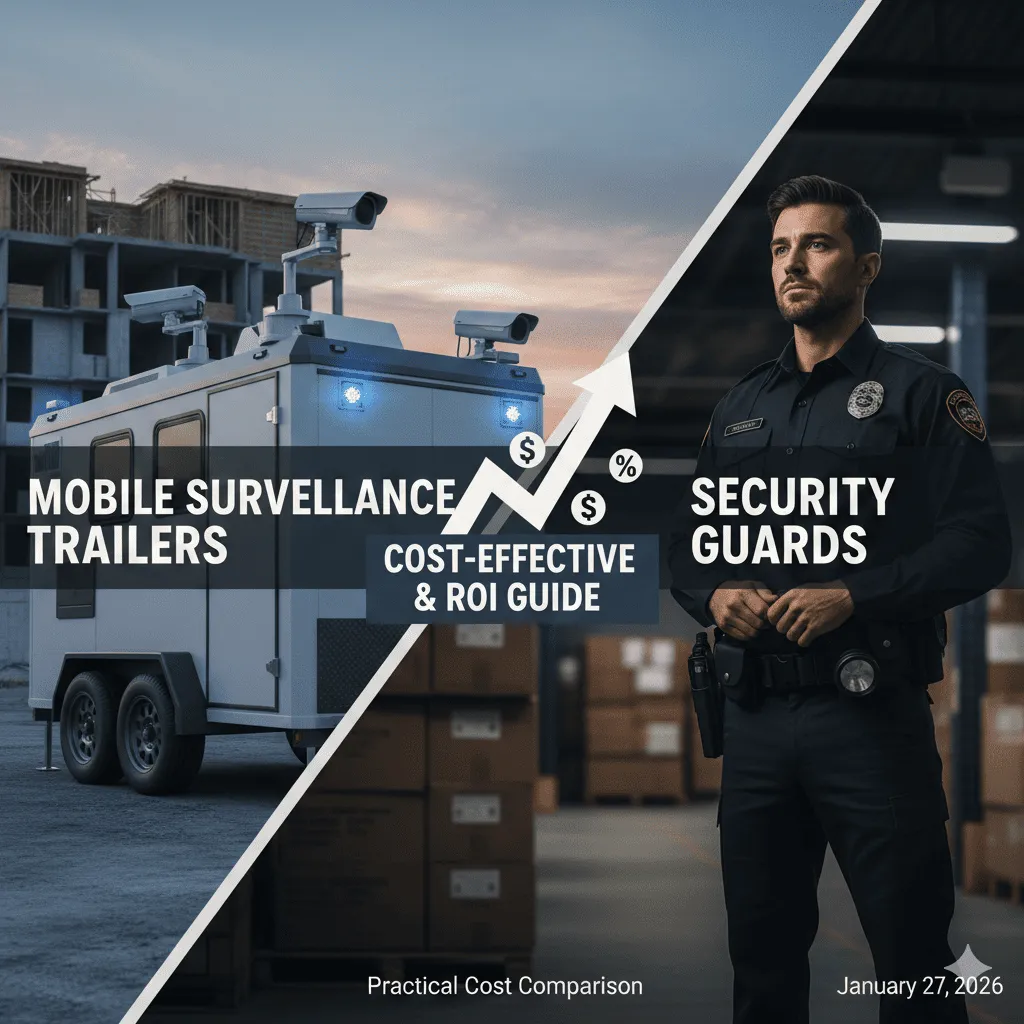
Affordable Site Security: Mobile Surveillance ROI Explained
For many short‑term or intermittent security needs, mobile surveillance trailers deliver lower, more predictable costs than hiring multiple full‑time guards. They reduce labor overhead, can lower insurance exposure, and cut potential asset‑replacement expenses. For organizations that want flexible coverage without the long‑term commitment of fixed systems, trailers are often the smarter choice.
What Are Mobile Surveillance Trailers and Security Guards? Defining the Core Options
Mobile surveillance trailers are self‑contained, towable security units fitted with cameras, sensors, independent power, and cellular or private network communications. They’re built for fast deployment and continuous monitoring at temporary or remote sites—deterring crime, recording evidence, and lowering staffing needs across construction sites, events, and critical infrastructure.
Security guards are trained personnel hired to patrol, observe, and intervene on site. They provide human judgment, on‑the‑spot incident handling, and direct interaction with people—advantages that remain important in many situations.
In short: trailers extend coverage affordably and consistently, while guards deliver immediate human intervention when it’s required.
Key Features and Benefits of Mobile Surveillance Trailers
Mobile surveillance trailers combine hardware, power, and connectivity to deliver reliable remote coverage. Core advantages include:
Core Components: High‑resolution cameras with strong low‑light and infrared performance.Independent power: solar arrays, battery banks, or generators for off‑grid operation.Robust communications: cellular (4G/5G), private LTE, or Wi‑Fi for live viewing and fast alerts.
Rapid Deployment: Position and activate units in minutes to a few hours, depending on site needs. Easily relocate or reconfigure coverage as site layouts change. Designed for towing and quick installation—ideal for events, construction, and emergency response.
Cost‑Effectiveness: Lower ongoing labor costs versus multiple round‑the‑clock guards.Predictable operating expenses and potential insurance savings.
Deterrence: Visible trailers discourage opportunistic theft and vandalism. Live monitoring and alerts speed intervention and evidence capture when incidents occur.
Versatile Applications: Suited for construction sites, outdoor events, remote infrastructure, and temporary projects.
Remote Monitoring: Trained operators can watch multiple sites from a central console. Real‑time alerts and remote PTZ control improve response precision.
System Integration: Integrates with existing alarms, access control, and cloud platforms for unified incident management.
Weather Resistance: Rugged housings and components keep units operational in adverse conditions.
What Security Guards Provide — and Where They’re Limited
Security guards bring human judgment, on‑site engagement, and the ability to intervene immediately—important for crowd control, threat de‑escalation, and situations that require a physical presence. Their effectiveness can be affected by fatigue, coverage limits, and the overhead of hiring, training, and managing personnel. For many short‑term or widely distributed needs, trailers can deliver broader, more consistent coverage at lower cost.
How Do Trailer Costs Stack Up Against Security Guard Expenses?
Overall, mobile surveillance trailers often offer lower total costs for temporary or intermittent coverage compared with hiring multiple round‑the‑clock guards. Trailers reduce labor line items, simplify budgeting with predictable operational expenses, and can lower insurance and replacement costs tied to theft or vandalism.
Upfront and Operational Costs for Mobile Surveillance Trailers
Specific purchase and operating costs vary by model, power configuration, camera suite, connectivity, and site conditions. For precise estimates tailored to your site and objectives, consult a CVT specialist who can model upfront investment, runtime, and expected operating expenses.
Hourly Rates, Benefits, and Hidden Costs of Security Guards
Guard costs depend on location, experience, required duties, and shift coverage. In addition to hourly wages, factor in benefits, training, overtime, management overhead, and liability insurance. These add‑ons can make long‑term guard coverage significantly more expensive than a mobile surveillance deployment for many use cases.
Return on Investment for Mobile Surveillance Solutions
ROI from mobile surveillance comes from direct cost savings (reduced staffing, lower insurance exposure, fewer asset losses) and operational gains (faster detection, better evidence capture, centralized management). When deployed appropriately, trailers deliver predictable operating costs and measurable value compared with long‑term fixed systems or extensive guard rosters.
Calculating tangible ROI for mobile services requires clear, site‑specific assumptions—power, uptime, incident reduction, and replacement cost avoided are common inputs.
Mobile Service ROI Calculation Algorithm
Based on published research and a sample mobile clinic model, an ROI framework compares the annual value delivered by a mobile service to its annual operating cost. The relative value equals projected emergency costs avoided plus quantified life‑year benefits from services provided. The ROI ratio is that relative value divided by the clinic’s annual operating cost—an approach adaptable to mobile security deployments when you substitute security‑specific savings for health outcomes.
How Mobile Surveillance Trailers Produce Measurable Savings
Trailers make savings measurable by replacing multiple guard shifts, shortening incident response times, and providing reliable video evidence—reducing both direct loss and investigative labor. Their predictable operating model also simplifies budgeting compared with the fluctuating costs of personnel.
Intangible Benefits That Strengthen ROI
Beyond direct savings, trailers improve situational awareness, support faster incident resolution, and reinforce a visible security presence that reduces opportunistic crime. These softer benefits—fewer disruptions, improved project uptime, and smoother insurance negotiations—add meaningful value over time.
Operational Advantages of Trailers Over Guards
Mobile trailers deliver several operational benefits:
Lower ongoing labor costs: Reduce the need for multiple personnel working around the clock.
24/7 monitoring: Continuous recording and remote observation support faster, evidence‑backed responses.
Rapid deployment: Close security gaps in minutes to a few hours.
Flexibility: Move coverage as site risks evolve.
Deterrence: A visible monitored presence discourages theft and vandalism.
Centralized remote monitoring: Operators can manage several sites from a single control point.
Technology integration: Use AI analytics, cloud storage, and wireless systems to reduce false alarms and surface actionable events.
How 24/7 Remote Monitoring and AI Analytics Improve Outcomes
Constant remote monitoring paired with AI analytics lets operators prioritize real threats, reduce manual review time, and act on high‑priority alerts. Operators can pan/tilt/zoom cameras remotely, pull footage from the cloud, and coordinate responses with law enforcement—making multi‑site operations more efficient and investigation workflows faster.
The move to AI‑driven, cloud‑enabled security marks a clear shift away from resource‑intensive, reactive methods toward proactive, data‑driven protection.
AI vs. Traditional Crime Prevention: Efficiency & Cost
Traditional prevention relied heavily on human patrols and limited data, which can be reactive and labor‑intensive. Modern AI systems use patterns, video analytics, and anomaly detection to highlight relevant events in real time—shifting security from manual, time‑consuming workflows to proactive, scalable monitoring that reduces false alarms and improves response efficiency.
Benefits of Rapid Deployment and Scalability
Rapid deployment and scalable fleet management mean you can:
Close coverage gaps quickly: Deploy units in minutes to hours during critical windows.
Reassign coverage: Move trailers as project priorities change.
Simplify logistics: Towable designs speed installation for events and emergency response.
Control costs: Scale units up or down to match project timelines, avoiding long‑term overhead.
Improve oversight: Centralized platforms let teams retain footage, manage alerts, and coordinate across sites.
When Are Security Guards Still Essential?
Guards remain essential where immediate physical intervention, crowd control, or on‑site customer interaction is required. Typical examples include high‑risk industrial sites (oil & gas, mining), large public events that need crowd management, and situations where a visible human presence is required for deterrence or legal response. Many organizations use a hybrid approach—trailers for broad coverage plus guards where direct human response matters most.
Human Limitations That Affect Guard Effectiveness
Guards can be limited by fatigue, coverage area, and split attention between tasks. Human judgment is valuable but can lead to inconsistency; combining human teams with trailer‑based monitoring and AI analytics often produces the best overall outcome.
Which Use Cases Require On‑Site Personnel?
Use cases that typically need on‑site personnel include high‑risk facilities, situations requiring immediate physical intervention, and events with dense crowds or complex access control needs. For many other scenarios—temporary yards, remote infrastructure, and interim project sites—mobile surveillance provides an efficient, cost‑effective alternative.
How Can Businesses Customize Cost‑Effective Security Solutions with CVT?
CVT helps businesses tailor mobile security by matching trailer power, camera systems, and communications to each site. Our units support custom alerts, strong low‑light performance, and a single dashboard for fleet management. Solutions are accessible via any web‑enabled device, and our team will configure analytics, retention, and monitoring workflows to fit operational needs. Contact a CVT security expert for a site‑specific plan.
Industries CVT Supports with Mobile Surveillance Trailers
Healthcare
Infrastructure
Law Enforcement
Government
Entertainment
Housing
Organized Retail Crime
Military
Retail
Construction
Transportation
Education
Property Management
Car Dealerships
Request a Quote, Demo, or Consultation
Request a custom quote, demo, or consultation by calling +1(800) 450-9006 or emailing [email protected]. Our team will evaluate your site and recommend the most cost‑effective configuration.
Frequently Asked Questions
What are the key differences in deployment time between mobile surveillance trailers and security guards?
Trailers can be positioned and operational in minutes to a few hours, giving immediate coverage for urgent needs. Guards require hiring, scheduling, and training, which can delay deployment—making trailers the faster option for many temporary or rapidly changing sites.
How do mobile surveillance trailers enhance situational awareness compared to security guards?
Trailers provide continuous, centralized monitoring and real‑time alerts—allowing trained operators to monitor multiple locations and quickly escalate incidents. Guards offer focused local awareness and direct intervention but cannot observe multiple dispersed sites simultaneously, unlike remote monitoring.
What types of industries benefit most from mobile surveillance trailers?
Construction, healthcare, entertainment, retail, utilities, and remote‑site operations frequently benefit from mobile trailers. They’re ideal for temporary coverage, off‑grid operation, or flexible redeployment.
Can mobile surveillance trailers integrate with existing security systems?
Yes. Trailers can integrate with alarms, access control, and cloud platforms to create a unified incident management system—so mobile monitoring complements your existing security infrastructure.
What are the environmental considerations for using mobile surveillance trailers?
Many trailers use solar power and battery banks to reduce fuel consumption and noise. Rugged, weather‑resistant designs also keep systems running in adverse conditions—making them a sustainable option for remote monitoring.
How do mobile surveillance trailers contribute to reducing insurance costs?
Visible, monitored security reduces the likelihood of theft and vandalism. Insurers often provide more favorable terms for properties with demonstrable, proactive security measures—so trailers can help lower premiums over time.
What training is required for personnel operating mobile surveillance trailers?
Operators typically train on the surveillance platform, monitoring protocols, and emergency response procedures. Additional training covers data privacy, evidence handling, and communication with law enforcement when needed.
Conclusion
Mobile surveillance trailers offer a flexible, cost‑effective security solution—especially for short‑term and remote needs. Their rapid deployment, continuous monitoring, and integration with AI and cloud tools make them a practical alternative or complement to traditional guard programs. If you need reliable coverage without permanent overhead, explore CVT’s mobile solutions to find the right fit for your sites.